Product updates

Candidate updates

What changed in the quiet-search workflow, why it matters, and where to find it.

Browse company updates

A clearer path from signal to next move

Today, Review, Radar, and Pipeline now make the next useful action easier to scan and act on.

WorkflowAccessibilityCandidate
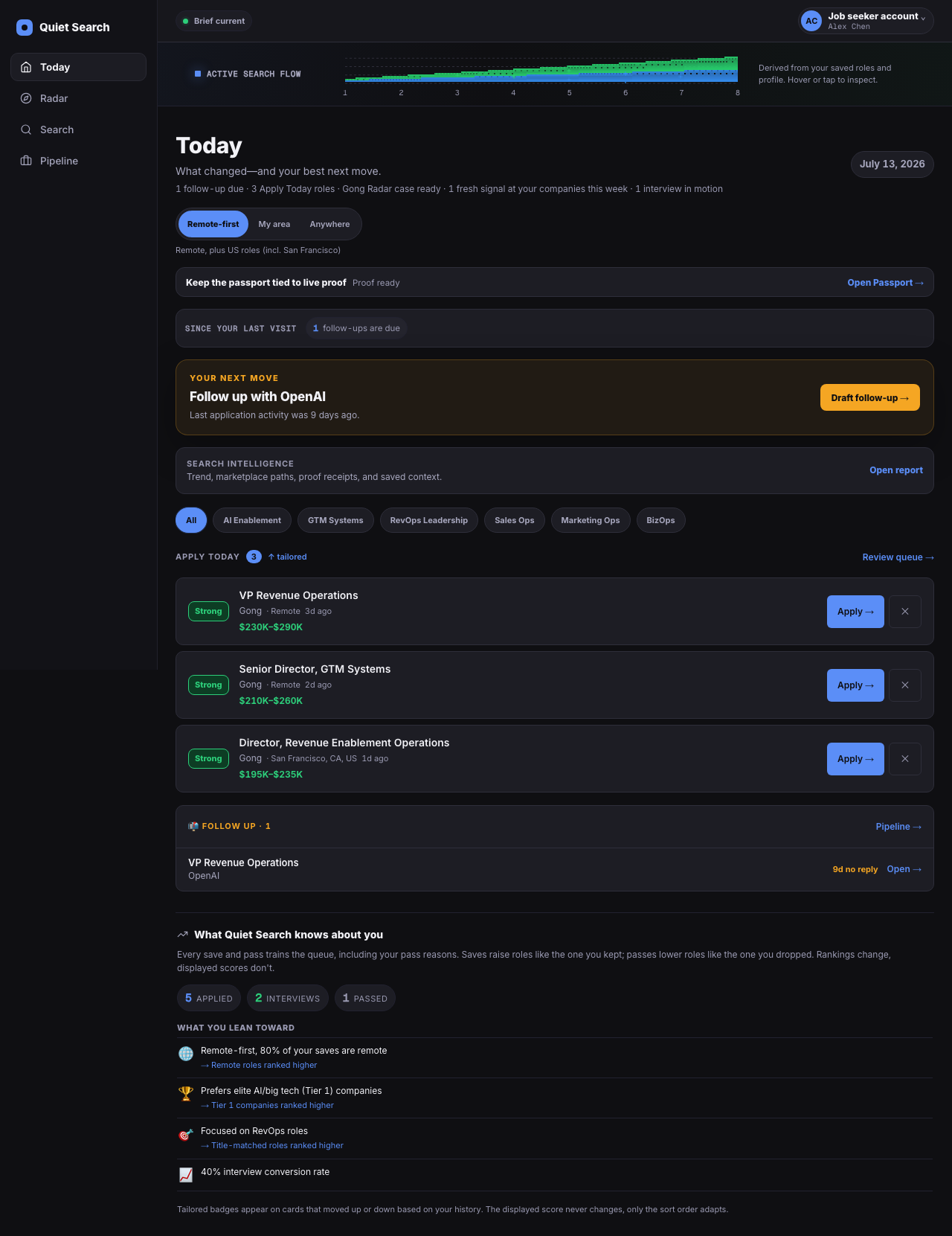
Quiet Search Today screen showing the current next move, role recommendations, and follow-up work

What changed

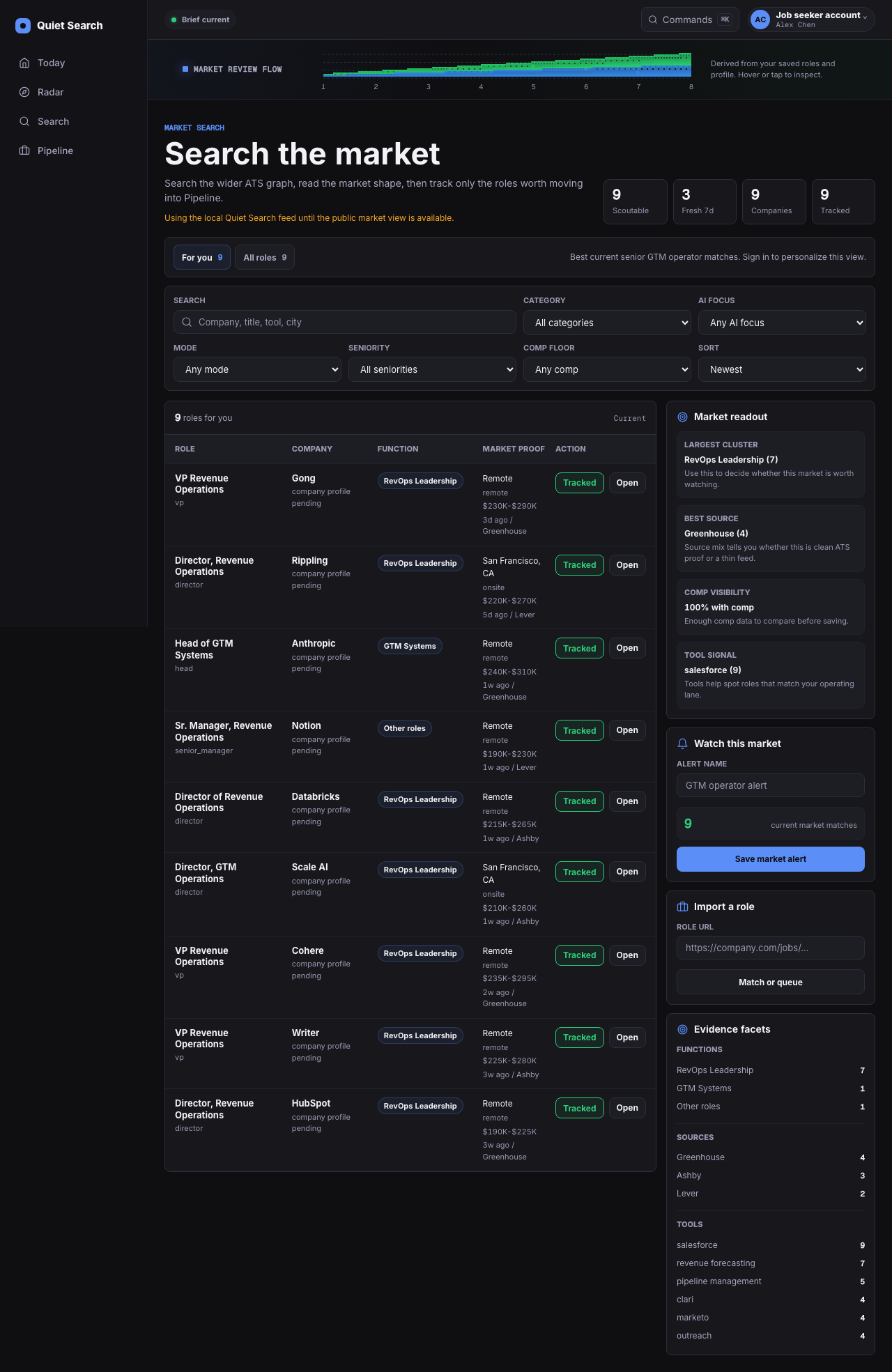
The core navigation now follows the real search loop: decide what matters today, review roles, inspect dated market movement, and move active opportunities forward.

Primary actions, loading states, filters, keyboard controls, and mobile layouts were tightened across the main candidate surfaces.

Why it matters

A job search already creates enough context switching. The updated hierarchy keeps the evidence and the next move in the same decision area.

Find it in Quiet Search

Open Today for the current priority, Review for the maybe-pile, Radar for company movement, or Pipeline for active work.

Public-data receipts you can inspect

Market context now keeps its source, timestamp, and availability close to the claim it supports.

Privacy & proofSearch & rankingCandidate

What changed

Quiet Search added free public-data sources for occupation context, company activity, and current opportunities.

Signal copy was rewritten around speed and reaching the right person, with visible receipts replacing unsupported prediction language.

Why it matters

You can judge whether a piece of market context is current and useful without taking an opaque score on faith.

Find it in Quiet Search

Inspect the source and date beside market context in Radar, Search, and company intelligence.

Search memory you can inspect and control

Saved, passed, and applied decisions now show how they shape the roles Quiet Search brings forward.

Privacy & proofSearch & rankingCandidate

What changed

Profile memory and AI receipts became visible instead of remaining hidden behind ranking behavior.

The focused search loop connects role decisions, profile context, and the next recommended action.

Why it matters

Personalization is more useful when you can see what the product remembers and correct it when your search changes.

Find it in Quiet Search

Review remembered preferences in Profile and inspect decision context from Today and Review.

Your decisions teach the next ranking

Quiet Search now makes the learning loop visible and uses explicit save and pass decisions to refine what appears next.

Search & rankingWorkflowCandidate

What changed

The product surfaces the functions, locations, and role patterns reinforced by your decisions.

Today was rebuilt as an evidence-first brief, while Radar gained clearer recency and source treatment on desktop and mobile.

Why it matters

Ranking changes are easier to trust when the product shows the decisions behind them rather than presenting a mysterious percentage.

Find it in Quiet Search

See the learning summary below Today and use save or pass in Review to update it.

A faster role-review loop

Role cards became leaner, decisions became more explicit, and the app started loading less work before the first useful screen.

WorkflowReliabilityCandidate

What changed

Review moved to a clearer save-or-pass interaction with deeper learning from explicit decisions.

The authenticated app shell and non-critical monitoring work were deferred so the useful interface could appear sooner.

Why it matters

The review queue should feel like a short decision session, not another dense job board.

Find it in Quiet Search

Open Review to work through the current queue on desktop or mobile.

Dated movement, not prediction theater

Company movement was reframed around inspectable events and practical outreach timing instead of unsupported certainty.

Privacy & proofWorkflowCandidate
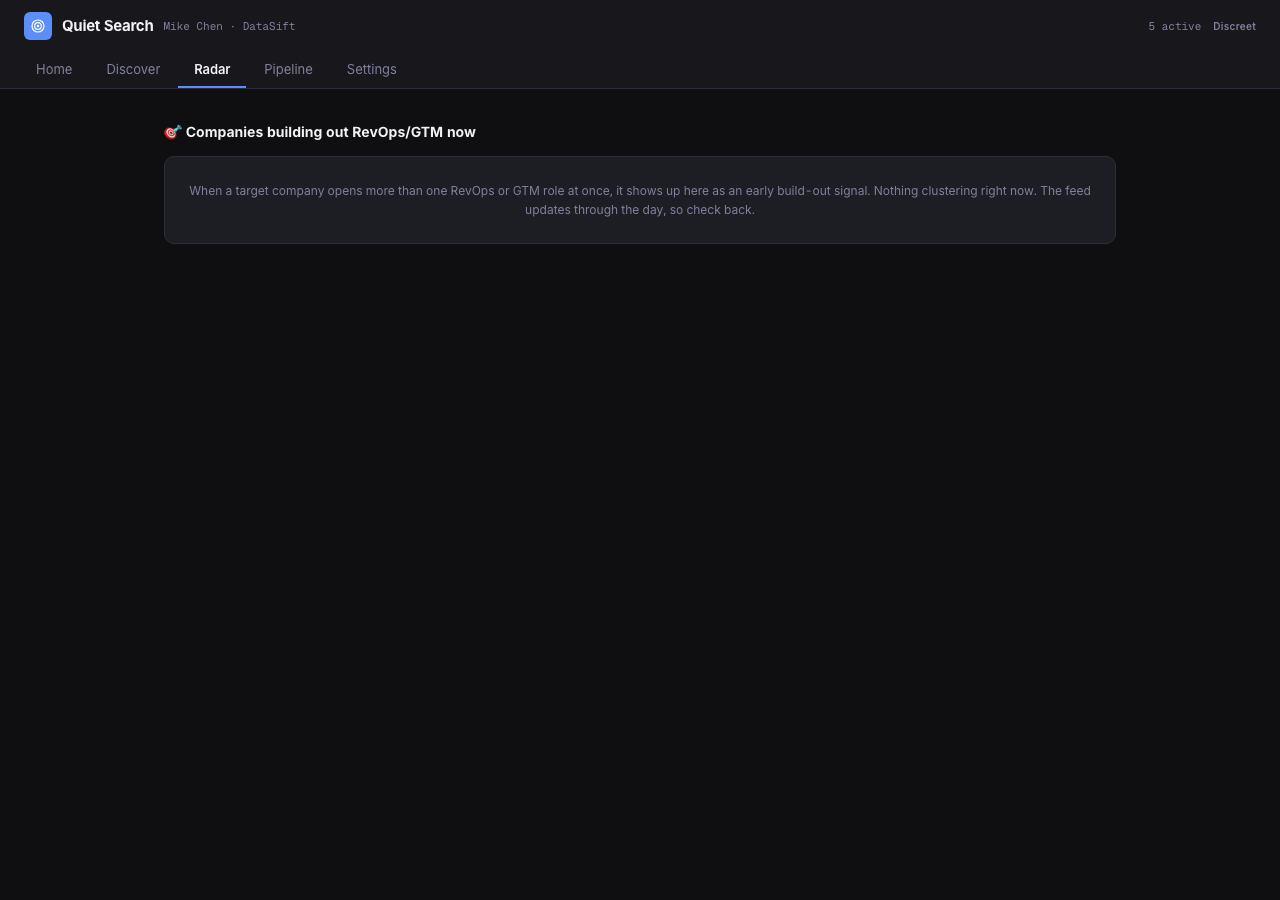
Quiet Search Radar screen from June 2026 showing dated company movement and evidence

What changed

Radar began emphasizing genuine funding, leadership, hiring, and risk events with dates and source context.

The landing and onboarding flow were simplified, and a fabricated demo offer was removed.

Why it matters

A weak signal should stay weak. The product now helps you investigate timing without pretending it knows that a role will appear.

Find it in Quiet Search

Open Radar and inspect the source and age attached to each company case.

Scout became Quiet Search

The private project gained its permanent name and a clearer first-run path for a quiet, evidence-led search.

Early buildWorkflowCandidate

What changed

User-facing Scout language was replaced with Quiet Search across the app, notifications, and service surfaces.

Search criteria, remote preferences, authentication, and first-run data loading were made more consistent.

Why it matters

This established the product identity and the basic privacy-conscious workflow the later experience builds on.

Find it in Quiet Search

This is an archive milestone from the founder-used private build.

The first private search loop

The original founder-used build connected role collection, daily recommendations, job details, and application tracking.

Early buildWorkflowCandidate

What changed

A Supabase-backed role feed, automated scanner, email digest, recommendation layer, and job-detail workflow came together in the first working product loop.

The build was created for the founder's own search and was not offered as a public beta.

Why it matters

This is the origin of the product: one place to reduce search noise and keep the next useful action visible.

Find it in Quiet Search

This entry documents the private product origin; the current experience has changed substantially since then.